A Deep Dive Into the Mind, Archetypes, and Universal Laws
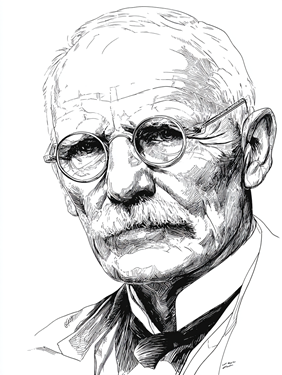
Carl Gustav Jung (1875–1961) was one of the most profound explorers of the human psyche. His work bridged psychology, mythology, spirituality, and symbolism, making him a rare figure who stood with one foot in science and the other in the mystical traditions of the ancient world.
At the same time, the Hermetic text The Kybalion presents seven universal principles to explain how consciousness creates reality. Though Jung never publicly cited The Kybalion, the parallels between the two systems are striking—almost as if both were tapping into a profound, underlying truth about how the universe and the mind function.
This article blends both worlds, showing you who Jung was, what he taught, and how his ideas harmonize with The Kybalion.
Who Was Carl Jung?
Carl Jung was a Swiss psychiatrist and the founder of Analytical Psychology. Unlike Sigmund Freud—under whom he originally trained—Jung believed the psyche was not driven solely by instinct or trauma, but by spiritual purpose, symbolic meaning, and innate patterns that guide human growth.
Jung’s major contributions include:
1. The Collective Unconscious
Jung proposed that beneath your personal memories lies a deeper layer of mind shared by all humanity—a vast reservoir of symbols, mythic patterns, and archetypal energies.
2. Archetypes
These universal symbols—such as the Hero, Shadow, Mother, or Wise Old Man—appear in dreams, myths, religions, and human behavior across all cultures.
3. The Shadow
Jung taught that each person carries an unconscious side containing emotions, traits, and memories we reject or suppress. Actual psychological growth requires integrating this “shadow” into conscious awareness.
4. Synchronicity
Jung coined this term to describe meaningful coincidences that seem to defy logical cause-and-effect. He believed such events reflect the deeper interconnectedness of mind and reality.
5. Introversion & Extraversion
Jung introduced these concepts long before modern personality tests. He saw them as fundamental attitudes of the psyche:
- Introversion: energy flows inward
- Extraversion: energy flows outward
6. Individuation
The highest goal of Jung’s psychology is individuation—a lifelong process of integrating all parts of the self until a person becomes whole, balanced, and fully authentic.
The Kybalion’s Seven Principles (Quick Overview)
- Mentalism – All is Mind; the Universe is Mental.
- Correspondence – As above, so below; as within, so without.
- Vibration – Nothing rests; everything moves.
- Polarity – Everything has two poles; opposites are the same in nature.
- Rhythm – Everything rises and falls; cycles are universal.
- Cause and Effect – Every cause has its effect; every effect has its cause.
- Gender – Everything has masculine and feminine principles.
Carl Jung vs. The Kybalion: A Comparative Breakdown
Though Jung came from a scientific background and The Kybalion comes from Hermetic mysticism, the parallels are so strong that they feel like two interpretations of the same truth. Below is a principle-by-principle comparison.
1. Mentalism vs. The Collective Unconscious
Kybalion Principle:
All reality begins in the mind. Consciousness is the root substance of existence.
Jung’s Contribution:
Jung believed the psyche—especially the deep unconscious—shapes perception, behavior, dreams, and even “coincidences” (synchronicity). His view that the unconscious molds reality aligns with Mentalism’s core idea.
Synthesis:
Both systems see mind as the architect of experience, with an invisible inner world shaping the visible outer world.
2. Correspondence vs. Archetypes
Kybalion Principle:
“As within, so without; as above, so below.”
Jung’s Contribution:
Archetypes manifest internally (in dreams) and externally (in myths, religions, stories, and relationships). The patterns are the same in every direction.
Synthesis:
Jung offers a psychological explanation for Correspondence:
The patterns in the human psyche mirror the patterns in the universe itself.
3. Vibration vs. Synchronicity & Psychic Energy
Kybalion Principle:
Everything vibrates and radiates energy.
Jung’s Contribution:
Jung described psychic energy (libido) as constantly flowing, transforming, and manifesting. Synchronicity expresses vibrational alignment between inner states and outer events.
Synthesis:
Jung’s synchronicities can be viewed as vibrational “matches” between mind and environment.
4. Polarity vs. The Shadow
Kybalion Principle:
Opposites are identical in nature, differing only in degree.
Jung’s Contribution:
Jung’s Shadow is the “opposite polarity” of the conscious ego. Light vs. darkness, persona vs. shadow—these are polarities that must be reconciled.
Synthesis:
Both systems teach that integration of opposites leads to wholeness.
5. Rhythm vs. Psychological Cycles
Kybalion Principle:
Everything flows in cycles and seasons.
Jung’s Contribution:
Jung observed psychological rhythms:
- introversion ↔ extraversion
- expansion ↔ contraction
- growth ↔ withdrawal
He also studied cultural cycles through mythology.
Synthesis:
Jung provides a psychological version of universal rhythm.
6. Cause and Effect vs. Psyche & Projection
Kybalion Principle:
Nothing happens by chance; everything follows the law.
Jung’s Contribution:
Jung argued that much of what we perceive as “external causes” is actually a projection of our inner world. Meaning: inner causes create outer effects without our awareness.
Synthesis:
Both systems teach that understanding inner causes lets you direct outer effects.
7. Gender vs. Anima & Animus
Kybalion Principle:
Every force contains masculine and feminine qualities.
Jung’s Contribution:
Jung taught that each psyche contains the:
- Anima — feminine principle within men
- Animus — masculine principle within women
Balance between the two leads to psychological wholeness.
Synthesis:
Jung’s Anima/Animus is a direct psychological counterpart to Hermetic Gender.
Where Jung and the Kybalion Fully Align
- Both view consciousness as the root of reality.
- Both describe inner patterns reflected in outer experience.
- Both see life as a process of integration, balance, and becoming whole.
- Both emphasize symbolism, duality, and transformation.
- Both understand that spiritual truths appear through mind, myth, and experience.
Where They Differ
- The Kybalion is metaphysical; Jung is psychological.
- The Kybalion discusses universal laws; Jung focuses on individual psyche.
- The Kybalion instructs on manifesting reality; Jung analyzes how humans perceive and shape reality.
- Jung avoids declaring cosmic laws, preferring experiential interpretation.
But the overlap is undeniable.
Conclusion: Two Paths, One Truth
Carl Jung explored the human psyche with scientific precision, while The Kybalion outlines metaphysical laws that govern the universe. Yet together they reveal a simple, timeless truth:
Your inner world shapes your outer world.
Your mind creates your reality.
Your journey is to become whole.
Whether you approach transformation through Jung’s psychology or the Kybalion’s Hermetic wisdom, both paths lead to self-knowledge, integration, and mastery of the inner realm.